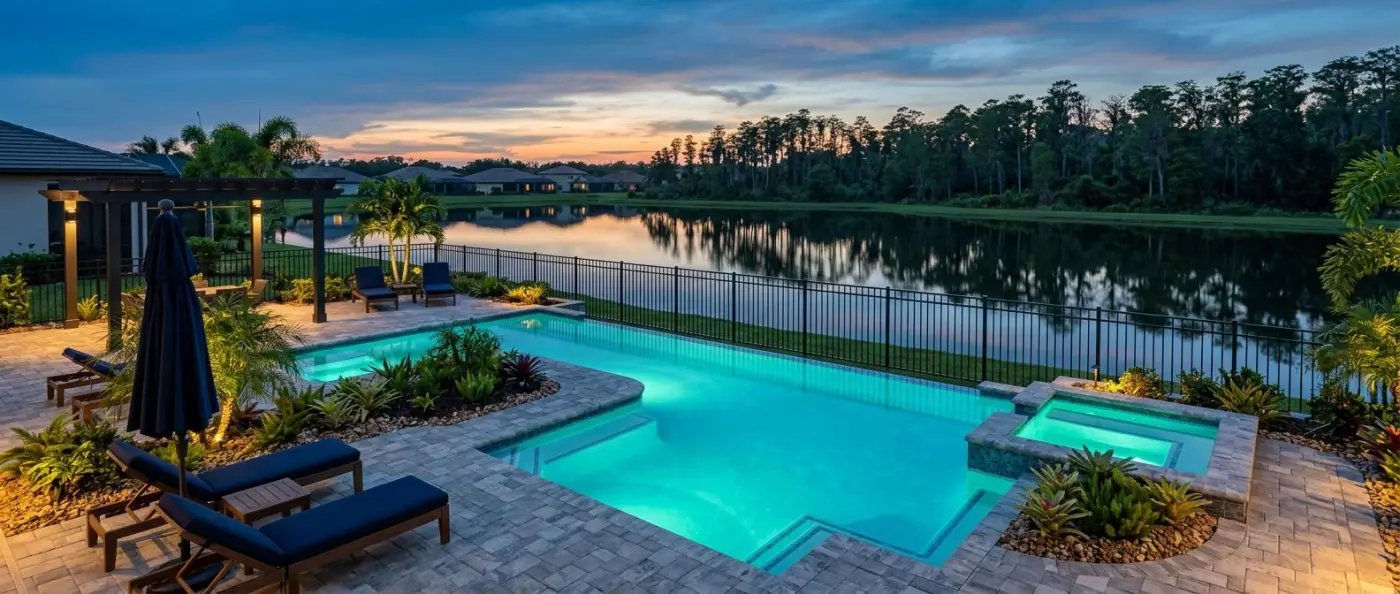
Whether it's a Spring Hill pool home on a quarter acre or a country place outside Brooksville with a pool behind the barn, the pool needs its own safe, code-compliant barrier. We build them in aluminum, vinyl and other materials across Hernando County.
The rules every pool barrier follows
State law sets the floor for every pool fence in Hernando County. The barrier has to stand at least 4 feet tall on the outside, wrap the whole pool, and leave nothing a small child could slip under, squeeze through or use to climb over. It also needs some distance from the water so anyone who does get past it can't tumble right in (Fla. Stat. 515.29).
The gate gets the strictest treatment: it must swing outward, away from the pool, close by itself and latch by itself, with the release on the pool side where a young child can't reach it. If a wall of the house forms part of the barrier, it can't have doors or windows opening straight onto the pool.
Pool barriers on rural properties
On acreage, fencing the whole property to serve as the pool barrier rarely makes sense, and farm fencing doesn't meet the barrier rules anyway. A dedicated aluminum enclosure around the pool and deck is usually the cleanest solution, with a gate positioned for the path from the house.
Materials that hold up out here
Aluminum shrugs off sun and rain and keeps the view across the property. Vinyl gives a private pool deck. Wood suits a rustic home, as long as the framing faces the pool so the outside stays smooth and unclimbable. Whatever you pick, we lay out the gate first, based on the path you actually walk from the house.